
Lake Powell has spent most of the 21st century far below the line engineers drew for a full reservoir. But it was full once, and it stayed near full for the better part of a decade. Here is exactly when — and why that high-water era ended.
The short answer
Lake Powell first reached full pool — 3,700 feet — on June 22, 1980, and crested at its all-time high of 3,708.34 feet in July 1983 during a flood that nearly overwhelmed Glen Canyon Dam. The last time the reservoir was essentially full was June 25, 1987, when the Bureau of Reclamation recorded a maximum elevation of 3,698.5 feet and logged it as 99% full. The lake climbed back near 3,696 feet around July 1999, then the Colorado River drought took over. It has not touched 3,700 feet since.
Lake Powell’s full-pool milestones
Every figure below is a fixed, dated elevation reading. Today’s live number is in the callout above.
| Date | Elevation | What it marks |
|---|---|---|
| June 22, 1980 | 3,700 ft | First reached full pool — 17 years after the dam closed |
| July 14–15, 1983 | 3,708.34 ft | All-time record high; spillways ran during a huge snow year |
| June 25, 1987 | 3,698.5 ft | Last time essentially full — Reclamation logged it as 99% |
| ~July 1, 1999 | ~3,696 ft | Rose near full one last time before the drought |
| April 13, 2023 | 3,519.92 ft | Modern record low until August 2026 — about 180 ft below full pool |
For the interactive chart of the most recent year, see the Lake Powell water level chart; for the full 1963-to-today story, see the water level history.
What “full pool” actually means
Full pool is the elevation at which Lake Powell’s storage reaches its designed maximum. For this reservoir that line is 3,700 feet above sea level, measured at Glen Canyon Dam, and the Bureau of Reclamation has used the same number in its operating plans for decades. Rise above it and inflows have to be passed downstream through the powerplant, the bypass tubes, or — in an emergency — the spillways.
At 3,700 feet the reservoir holds a lot of water. The site tracks a live capacity of about 24.3 million acre-feet; the original design capacity was closer to 26–27 million acre-feet, though decades of sediment washing in from the Colorado and San Juan Rivers have slowly cut the usable figure (USGS elevation-area-capacity survey). For how that translates into “how much water is in there,” see how much water is in Lake Powell. Full pool sits 330 feet above dead pool (3,370 feet), the elevation where water can no longer pass the dam by gravity at all.
When Lake Powell first filled
Lake Powell did not exist before Glen Canyon Dam. When the dam began impounding the Colorado River in 1963, the water started backing up into the red sandstone canyons of the Utah–Arizona border — and it filled far more slowly than anyone expected. The Navajo Sandstone that forms the canyon walls is porous, so a large share of the early inflow seeped into the rock rather than raising the lake, and the dam had to keep releasing water downstream the entire time (USGS EROS).
It took 17 years. The reservoir finally touched its full-pool elevation of 3,700 feet on June 22, 1980, according to records compiled from the U.S. Bureau of Reclamation. That single fill is the only time Lake Powell reached full pool cleanly under normal operations — everything after was either a flood overshoot or a near-miss.
The last time Lake Powell was full
Three years after filling, the lake did not just reach full pool — it blew past it. An unusually long, cold winter in 1982–83 loaded the Colorado River headwaters with snow, and a fast spring melt sent inflows toward 120,000 cubic feet per second into a reservoir that was already near full. Glen Canyon Dam’s tunnel spillways had to run hard, and the high-velocity water tore chunks of concrete out of the tunnels through cavitation. Crews bolted plywood-and-steel flashboards onto the spillway gates to buy a few feet of storage, and on July 14–15, 1983 the lake crested at 3,708.34 feet — about 8 feet over full pool, and 6.66 feet below the top of the dam at 3,715 feet. Reclamation’s position is that the dam itself “was never in danger of failing”; what was at risk was controlled spillway operation (Bureau of Reclamation). The full account is in the 1983 Glen Canyon Dam disaster.
After that scare, Reclamation ran the reservoir with more freeboard. The cleanest near-full reading in the record comes four years later: Reclamation’s 1987 Annual Operating Plan states that “the maximum lake elevation of 3,698.5 feet (99 percent full) was reached on June 25” (USBR 1987 AOP, PDF). That is the last time the agency’s own paperwork calls Lake Powell essentially full.
The lake came close once more. Around July 1, 1999 it stood near 3,696 feet — within about 4 feet of full pool — before the two-decade decline began (Grand Canyon Trust). That late-1990s stand is best described as near full rather than full; no source labels it 99% the way Reclamation labeled 1987. Add it up and Lake Powell’s annual peak sat within roughly 10 feet of full pool for about eight to ten years total — a cluster in the early-to-mid 1980s and one last brush in 1999. Treat that count as approximate; it comes from reconstructing peak elevations, not a single official ledger.
Why it hasn’t been full since
The water stopped coming. Beginning around 2000 the Colorado River basin entered what scientists call a megadrought, and unregulated inflow to Lake Powell averaged only about 80% of the late-20th-century norm across the following two decades, with some years far worse (NASA Earth Observatory). On top of the dry hydrology sits a structural problem: the river is over-allocated, promising roughly 1.2 to 1.5 million acre-feet more each year than it reliably delivers, so the reservoirs drain to cover the gap.
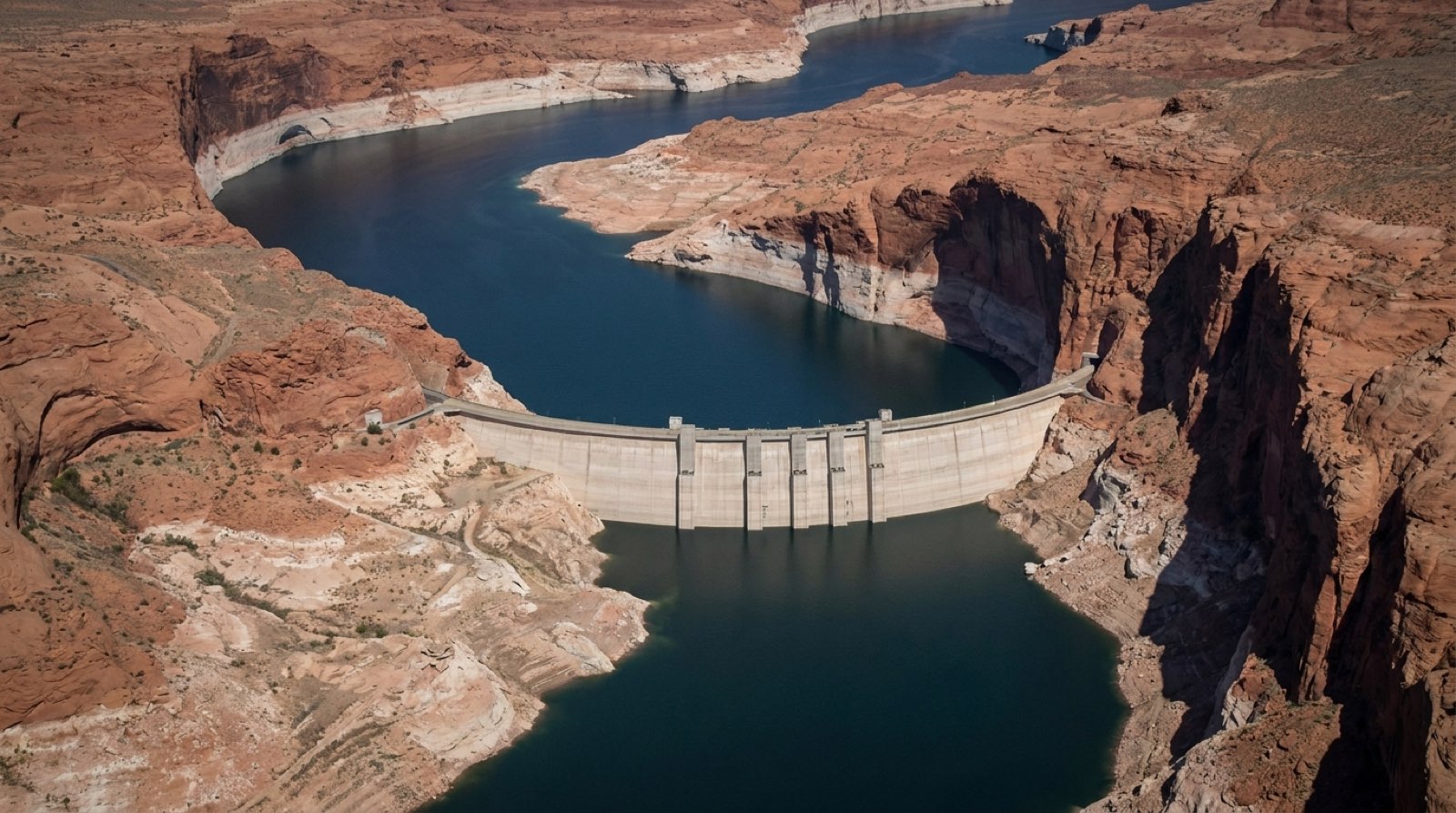
The result was a descending staircase — each drought trough lower than the last — bottoming at 3,519.92 feet on April 13, 2023, about 180 feet below full pool, a mark the lake fell below again on August 15, 2026. For the full explanation of the drivers, see why Lake Powell is so low.
Will Lake Powell ever be full again?
Not soon, on the honest read of the forecast. Wet winters still lift the lake — the strong 2023 snowpack raised it about 65 feet off its record low in a single season — but climbing from today’s elevation all the way back to 3,700 feet would take several consecutive exceptional snow years stacked on top of each other, and it would take deep, durable cuts in how much water the basin uses so those inflows could be stored instead of released downstream. Reclamation is currently managing Glen Canyon Dam to avoid the bottom of the range — minimum power pool at 3,490 feet, dead pool at 3,370 — not to chase full pool.
None of that is a firm prediction; a run of huge winters would rewrite the near term. But no current forecast projects a return to full, and most hydrologists treat 3,700 feet as improbable under the climate the basin now has. For where the level is actually headed, see the forecast page and will Lake Powell fill back up; for how much cushion is left at the bottom, see the dead pool tracker.
Sources
- U.S. Bureau of Reclamation — Glen Canyon Dam / Lake Powell operations (full-pool elevation, first fill to 3,700 ft in 1980, current operations)
- U.S. Bureau of Reclamation — 1987 Annual Operating Plan, Colorado River (PDF) (maximum elevation 3,698.5 ft, “99 percent full,” on June 25, 1987)
- U.S. Geological Survey — EROS Earthshots: Water Levels (reservoir finished filling in 1980; high in July 1983; low in April 2023)
- damfailures.org — Glen Canyon Dam, Arizona (1983) case study (1983 spillway emergency; 3,708.34-ft peak; 17-year fill and Navajo Sandstone seepage)
- Grand Canyon Trust — Lake Powell Levels, 1963–2025 (year-by-year elevation record, including the late-1990s near-full stand)
- NASA Earth Observatory — Lake Powell Still Shrinking (post-2000 inflow ~80% of average; drought-era decline)