
Lake Powell is one of the deepest reservoirs in the country, and the answer to “how deep” has two parts: the maximum it can hold, and how deep it actually is today. Those two numbers have drifted far apart over two decades of drought.
The short answer
Lake Powell’s maximum depth is about 560 feet, measured at Glen Canyon Dam, when the reservoir is at full pool (elevation 3,700 feet). But depth follows the surface: the water is deepest right at the dam and gets shallower upstream, and every foot the lake level drops takes a foot off the maximum. At today’s elevation, shown in the callout above, the lake sits well short of that 560-foot maximum.
Lake Powell’s depth at a glance
Every figure below is a fixed reference number. Today’s live elevation is in the callout above; subtract the riverbed to read depth.
| Measure | Figure | Notes |
|---|---|---|
| Maximum depth at full pool | ~560 ft | At Glen Canyon Dam, elevation 3,700 ft (USBR) |
| Deepest point | at the dam | Shallows steadily upstream toward Hite |
| Depth today | elevation − ~3,130 ft | Subtract the old riverbed from the callout’s elevation |
| Glen Canyon Dam height | 710 ft | Foundation to crest, taller than the water is deep |
| Length / shoreline | ~186 mi / ~1,900 mi | At full pool (NPS) |
How deep is Lake Powell at the dam?
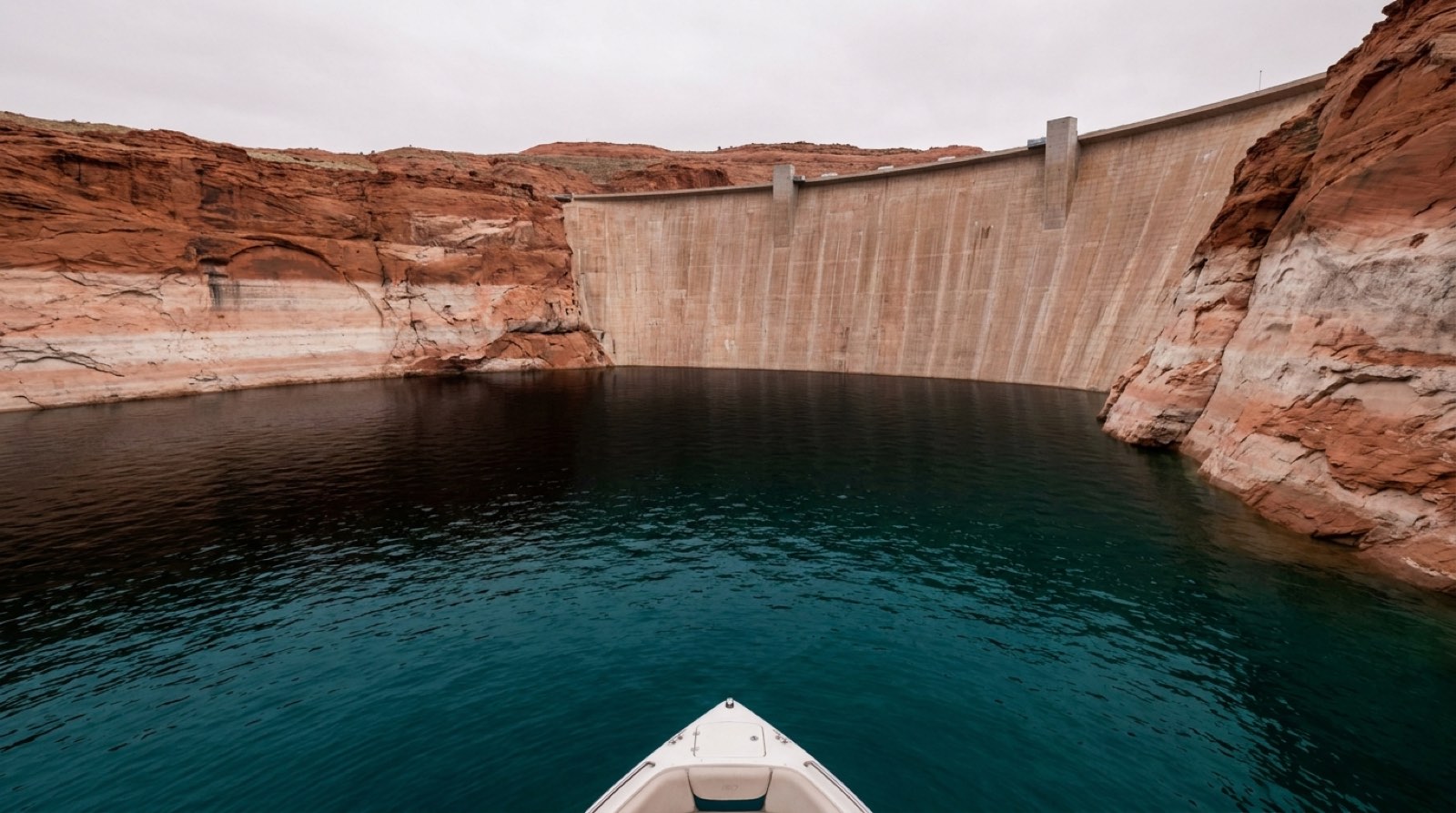
The deepest water sits against Glen Canyon Dam. At full pool, the U.S. Bureau of Reclamation puts the depth there at about 560 feet, the reservoir’s maximum anywhere. (You’ll also see 583 feet quoted; that figure is really the dam’s height above the original river channel, up to its crest, not the depth of the water. Reclamation’s full-pool water depth is about 560 feet.) From that deep spot at the dam, the bottom climbs as you head up-lake, so the reservoir runs only a few hundred feet deep through its middle reaches and shallows to nothing near Hite, 186 miles upstream, where the Colorado River flows back in.
That is why a single “how deep” number is always a little slippery. The lake is 560 feet deep in one specific place at one specific level, and much shallower almost everywhere else.
Why the depth changes every day
Depth is just the surface elevation minus the ground underneath. At the dam, the original Colorado River bed sits near 3,130 feet above sea level. So the lake’s maximum depth is whatever the surface reads, minus that roughly 3,130-foot floor. When Powell was full at 3,700 feet, that math left about 560 feet of water at the dam. Take today’s elevation from the callout above, subtract roughly 3,130 feet, and you have the current maximum depth.
That is also why the depth tracks the drought foot for foot. The surface has fallen well over 100 feet from full pool, and the depth at the dam has dropped by the same amount. For where the level sits against its records, see how low Lake Powell is and the full water level history. To read depth yourself, the water level chart plots the last 365 days of official readings, and its per-day archive holds any single date in that window, each with its own elevation. Subtract the riverbed from any of those numbers and you are reading depth.
Dam height isn’t water depth
Glen Canyon Dam is 710 feet tall, but the water behind it has never been 710 feet deep. The dam’s structural height runs from its foundation, keyed into bedrock below the old riverbed, up to a crest at 3,715 feet. Full pool sits 15 feet below that crest, at 3,700 feet, and the deepest water reaches only about 560 feet. The rest of the dam’s height is foundation buried below the riverbed plus freeboard, the safety margin between a full lake and the top of the dam. The dam is always taller than the lake is deep.
Is Lake Powell deeper than Lake Mead?
Yes, narrowly. At full pool Lake Powell reaches about 560 feet at Glen Canyon Dam; Lake Mead, behind Hoover Dam downstream, tops out around 532 feet. Powell is the deeper of the two by roughly 30 feet. Both rise and fall with the same over-stretched Colorado River, though, so the live gap between them shifts constantly. For how the two reservoirs stack up on capacity, elevation, and fill percentage, see Lake Powell vs. Lake Mead and which is in worse shape.
What’s at the bottom
Not just bedrock. Since Glen Canyon Dam’s gates closed in 1963, the Colorado and San Juan rivers have dropped their sediment wherever they hit still water, and that mud has been piling up on the reservoir floor ever since. A 2022 U.S. Geological Survey study found Lake Powell has lost about 6.8% of its original storage capacity to sediment, roughly 1.8 million acre-feet, filling in at around 33,000 acre-feet a year. Most of that sediment sits in deltas at the upstream ends near Hite, not against the dam, so the deep water at Glen Canyon stays deep. Over the long run, though, sediment means the reservoir holds a little less water at any given depth, one more way the lake behaves differently than its 1963 design. The reservoir’s hard floors below the water, dead pool and the riverbed under it, are tracked on the dead pool page.
Sources
- U.S. Bureau of Reclamation — Glen Canyon Unit / Lake Powell overview (full pool 3,700 ft, ~560 ft depth at the dam, first fill in 1980)
- U.S. Bureau of Reclamation — Glen Canyon Dam / Lake Powell operations (dam dimensions and current operations)
- U.S. Geological Survey — Lake Powell storage capacity and sedimentation, 1963–2018 (SIR 2022-5017) (6.8% capacity lost to sediment, ~33,000 acre-feet per year)
- National Park Service — Glen Canyon National Recreation Area (reservoir length ~186 miles, shoreline ~1,900 miles)
- Wikipedia — Lake Mead (maximum depth ~532 ft at full pool, for the Powell-vs-Mead comparison)