
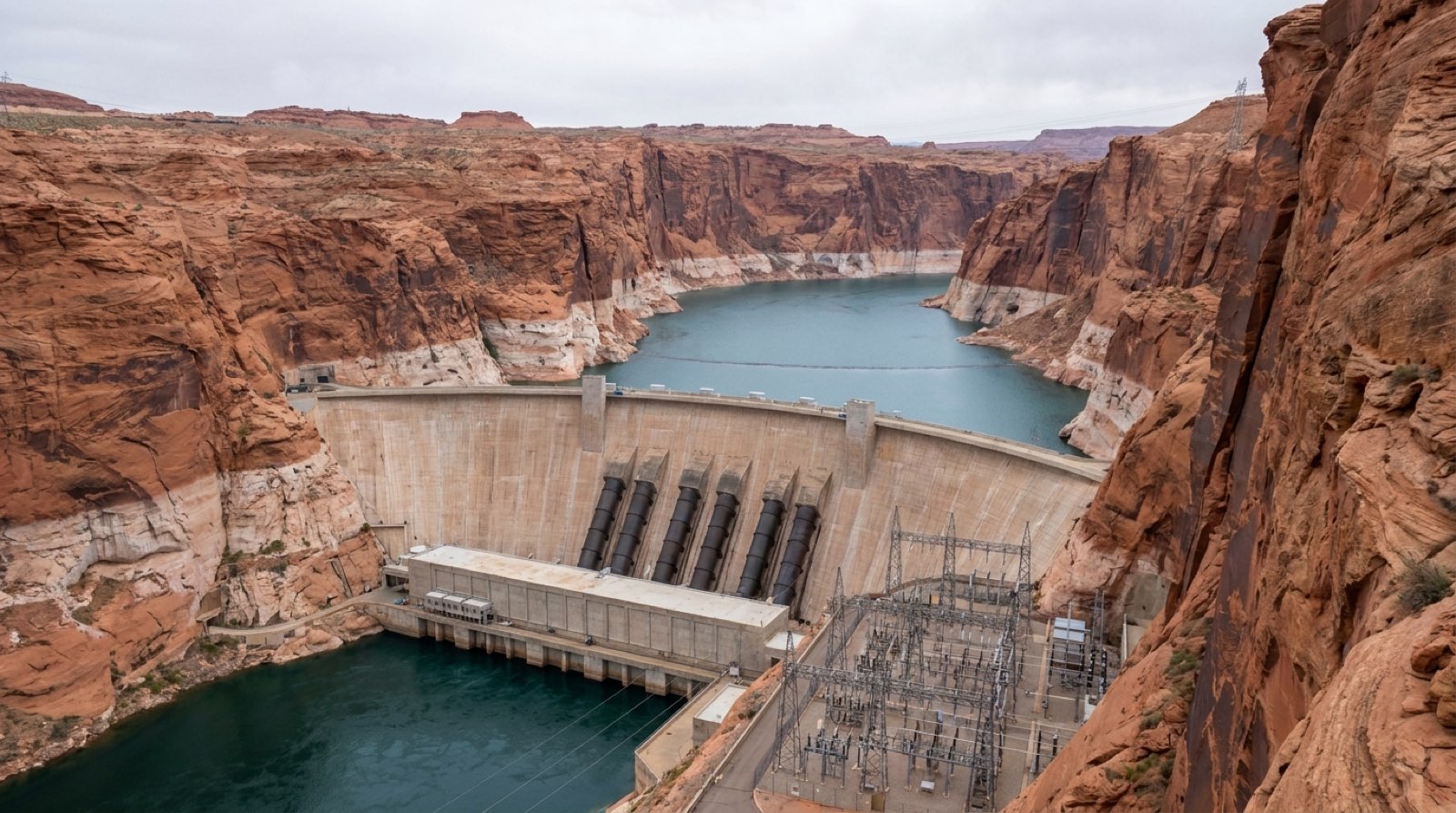
Most alarming Lake Powell headlines eventually name “dead pool.” The line the dam actually hits first is higher, and it is the one that turns off the lights: minimum power pool at 3,490 feet, where Glen Canyon Dam stops making electricity.
The short answer
Minimum power pool is elevation 3,490 feet. Below it, the penstocks that feed Glen Canyon Dam’s eight turbines lose the water depth they need to run safely, so the units shut down and hydropower stops. That takes up to 1,320 megawatts of carbon-free power offline for about five million customers across seven Western states, and it drains the revenue stream that funds much of the Colorado River’s environmental work. Water can still be released below that line, down to dead pool at 3,370 feet, but only through smaller pipes that were never built for the job.
What minimum power pool actually is
The number comes from the plumbing, not from policy. Glen Canyon Dam’s penstock intakes, the openings that pull water into the turbines, sit at elevation 3,470 feet. Reclamation set the minimum operating level 20 feet higher, at 3,490 feet, so the intakes keep enough water above them to run without trouble (Reclamation’s 2024 low-reservoir operating guidance).
That 20-foot margin exists to stop vortices. As the reservoir surface drops toward the intakes, swirling water can organize into whirlpools that funnel air down into the penstocks. Air in a high-velocity pipe means cavitation — vapor bubbles that collapse violently and pit steel, chew turbine blades, and shake the whole assembly. Reclamation shuts the units down at 3,490 feet to keep that from happening. The head, the vertical drop that drives the turbines, also shrinks as the lake falls, so each unit already makes less power well before it reaches the line.
| Release pathway | Capacity | Works down to | Role |
|---|---|---|---|
| Penstocks (powerplant) | ~33,200 cfs | 3,490 ft | Hydropower plus normal downstream releases |
| River outlet works | ~15,000 cfs | 3,370 ft | Backup and flood releases; no power |
| Spillways | 276,000 cfs | 3,648 ft | Flood control only |
Above 3,490 feet, the dam has two ways to move water and can generate power. Below it, only the outlet works remain, and the turbines are done. For the full ladder of thresholds from full pool to riverbed, see what is Lake Powell’s dead pool.
What the West loses when the power stops
Glen Canyon is not a small plant. Its eight turbines carry about 1,320 megawatts of nameplate capacity — uprated from the original 950 — and historically produced 4.5 to 5 billion kilowatt-hours a year of carbon-free electricity (USBR Upper Colorado, Glen Canyon Unit). The Western Area Power Administration markets that power as part of the Salt Lake City Area Integrated Projects, and it reaches roughly five million customers across Arizona, Colorado, Nevada, New Mexico, Utah, Wyoming, and Nebraska: cities, rural cooperatives, irrigation districts, more than 50 tribal utilities, and federal and state agencies.
When the turbines stop, all of those customers keep needing electricity — they just buy it somewhere else, on the open wholesale market, generally at a higher price than the federal hydropower rate. The output is already sliding. Generation that averaged around 4,600 gigawatt-hours a year in the 1990s fell to roughly 3,800 in the 2000–2020 window, and dropped to about 2,590 gigawatt-hours in 2022 when the lake hit record lows, a decline near 45 percent. Losing the plant entirely at minimum power pool would take the rest.
The hidden cost: what the power money pays for
The headlines skip where the money goes. Glen Canyon’s power sales feed the Colorado River Basin Fund, the account that bankrolls a large slice of the river’s federal work (Congressional Research Service report R47497). That fund repays the dam’s construction cost, covers operation and maintenance, and pays for programs that have nothing to do with electricity:
- Endangered fish recovery in the Upper Colorado and San Juan basins — the work keeping the humpback chub, razorback sucker, bonytail, and Colorado pikeminnow off the extinction line.
- Salinity control projects that pull salt out of the river before it reaches farms and cities downstream.
- The Glen Canyon Dam Adaptive Management Program, which studies and softens the dam’s effects on the Grand Canyon below.
Glen Canyon is the largest single generator in that portfolio, so when its output falls, the fund shrinks with it. A prolonged shutdown at minimum power pool would put the squeeze on programs that Congress and the Endangered Species Act require regardless of how much water is in the lake. The power line and the conservation budget are the same line.
Below the power line: the 3,490 to 3,370 band
Losing power is not the same as losing water delivery. Between minimum power pool and dead pool sits a 120-foot band where the dam can still release water, but only through the river outlet works — four eight-foot steel pipes near the left abutment. They top out near 15,000 cubic feet per second, less than half the penstocks’ ~33,200, and Reclamation is blunt that they were never meant to carry the whole river for months or years (Reclamation, Glen Canyon Dam operations).
A 2023 high-flow release through the outlets revealed fresh cavitation damage when they were run hard, and in 2024 Reclamation began relining all four, an $8.9 million project funded by the Bipartisan Infrastructure Law. The deeper problem is capacity: below roughly 3,440 feet, the outlets can no longer pass the 8.25 million acre-feet a year the Upper Basin is obligated to deliver downstream. So the outlet band buys time, but a narrowing amount of it. The live distance to both the power line and dead pool is on the dead pool page.
How managers are defending the 3,490 line
Reclamation is working hard to never test any of this. It operates to a target of 3,525 feet — a 35-foot cushion above minimum power pool, set under the Drought Response Operations Agreement to leave room to act before the turbines are at risk (DROA). Through 2026, holding that line has taken two levers at once:
- Cutting releases from Powell. Reclamation reduced the water year 2026 release from Glen Canyon Dam from 7.48 to 6.0 million acre-feet, the lowest in decades, to hold elevation in Powell.
- Sending water down from Flaming Gorge. Starting April 23, 2026, it began releasing 660,000 to 1 million acre-feet from Flaming Gorge Reservoir upstream to prop Powell up through spring 2027.
Both come at a cost to Lake Mead — less water leaving Powell means less arriving downstream — which is the whole tension of a two-reservoir system running dry at once. The live side-by-side is on Lake Powell vs. Lake Mead, and the deeper comparison is in which is in worse shape. Without those interventions, some federal analyses showed Powell risking the 3,490-foot line as early as late 2026. For where the runoff forecasts point next, the forecast page tracks Reclamation’s monthly 24-Month Study.
Has Lake Powell ever come close?
Not to the point of losing power. The 2023 low of 3,519.92 feet (April 13, 2023) sat only about 30 feet above minimum power pool, close enough that a shutdown was a real conversation that spring, before a near-record snowpack pulled the lake back.
On August 15, 2026 the lake fell below that 2023 mark, so the cushion is measured against the live reading in the callout above. See how low is Lake Powell for how today’s level stacks up against that record, and when will Lake Powell reach dead pool for the timing on both thresholds. The full decline is on the water level chart.
Sources
- U.S. Bureau of Reclamation — Glen Canyon Dam / Lake Powell operations (thresholds, releases, outlet works, drought response)
- U.S. Bureau of Reclamation — Establishment of Interim Operating Guidance for Glen Canyon Dam Low Reservoir Levels (2024) (3,470 ft penstock centerline, 20-ft submergence margin, vortex/cavitation, release capacities)
- U.S. Bureau of Reclamation — Glen Canyon Unit, Colorado River Storage Project (1,320 MW capacity, annual generation, customers served)
- Western Area Power Administration — Colorado River Storage Project marketing (SLCA/IP, power distribution)
- Congressional Research Service — “Glen Canyon Dam and the Colorado River,” R47497 (Colorado River Basin Fund, environmental programs, 8.25 MAF compact delivery, outlet-capacity limits)
- U.S. Bureau of Reclamation — Drought Response Operations Agreement (3,525 ft target, Flaming Gorge releases)