
“Dead pool” is the phrase most drought headlines reach for, and the natural follow-up is a date. But the reservoir hits a different line first: minimum power pool at 3,490 feet, roughly 120 feet above dead pool.
The short answer
No official forecast shows Lake Powell reaching dead pool — elevation 3,370 feet — within the next five years. The threshold managers actually plan around is minimum power pool at 3,490 feet, about 120 feet higher, where Glen Canyon Dam’s turbines shut down. The U.S. Bureau of Reclamation’s June 2026 24-Month Study projects Powell crossing that power-pool line around spring 2027 in its most-probable case. Dead pool doesn’t appear in any of Reclamation’s official projections — it’s the logical endpoint of a decline that never reverses, not a dated event.
What the forecast actually shows
| Elevation milestone | Feet | What the June 2026 forecast shows |
|---|---|---|
| Today’s level | see callout above | Live elevation and percent-full, updated daily |
| End of 2026 | ~3,505 ft | The most-probable 24-Month Study projection |
| Minimum power pool | 3,490 ft | Central case crosses it around spring 2027; hydropower stops |
| Dead pool | 3,370 ft | Not reached in any of Reclamation’s five-year projections |
Two forecasts carry the weight here. The 24-Month Study is Reclamation’s monthly deterministic model; it runs a most-probable, a minimum-probable (dry), and a maximum-probable (wet) trace two years out. The five-year probabilistic projections (CRSS) run hundreds of hydrologic sequences to put odds on crossing each critical elevation. Those runs treat minimum power pool as a real but minority risk in the near term — and not a single one of them reaches dead pool at 3,370 feet.
That is the number to hold onto: dead pool is not a forecast. It is the logical endpoint of the current trajectory if the decline never stops, not a dated event in Reclamation’s planning window.
The line that matters first: minimum power pool
Minimum power pool is where the real near-term story lives. At 3,490 feet, the penstocks that feed Glen Canyon Dam’s eight turbines lose enough submergence that they risk drawing air, so Reclamation shuts the units down to avoid cavitation damage. Power stops there — roughly 120 feet before water delivery stops at dead pool. The full ladder of thresholds, from full pool to riverbed, is laid out in what is Lake Powell’s dead pool.
The June 2026 24-Month Study put Powell near 3,505 feet by the end of 2026 and trending toward the 3,490-foot line by spring 2027 under most-probable inflows — even with emergency releases from upstream propping the reservoir up. Reclamation’s own framing of that study described Powell “reaching minimum power pool in spring 2027.” Reporting on federal risk analyses has floated earlier crossings, with hydropower potentially threatened before the end of 2026 under drier assumptions. Those are the pessimistic edge of the range, not the central path.
Dry, probable, or wet: why the date is a range
Ask “when” and the only honest answer is “it depends on the snow.” Lake Powell’s inflow comes almost entirely from Rocky Mountain snowpack, and one winter can swing the timeline by a year or more. That is why Reclamation publishes scenarios instead of a single date.
| Inflow scenario (24-Month Study trace) | What it does to the timeline |
|---|---|
| Probable Maximum (wet winter) | A big snow year adds elevation and pushes every threshold further out |
| Most Probable (central case) | Minimum power pool around spring 2027; dead pool not reached in the modeled window |
| Probable Minimum (dry winter) | Power-pool risk pulls toward late 2026; dead pool still absent from the runs |
The 2026 water year shows why the dry edge is getting attention. Upper Basin snowpack peaked early and then collapsed under record warmth — Colorado’s statewide snow water equivalent fell to roughly 22% of median by April 9, 2026 (NRCS SNOTEL data), with the vast majority of monitoring sites at or near their lowest readings on record. Reclamation’s forecasts followed the snow down: the April–July unregulated inflow to Powell was pegged at less than a fifth of normal, and the full water year near 36% of normal (USBR Upper Colorado operations). A year like that is what makes the low-probability scenarios feel less theoretical — and why 2026 set a record for the lowest summer level the reservoir has ever seen. For where the runoff forecasts point next, the forecast page tracks the 24-Month Study in plain English.
What would have to happen to reach dead pool
Getting to 3,370 feet is not one bad winter — it is a chain of them, plus a breakdown in management. Three things would all have to line up.
- Inflows stay at or below the minimum-probable level for years. A single dry year, like 2026, drops the lake tens of feet. Reaching dead pool needs that to repeat without a recovery winter in between.
- Emergency interventions fail or run out. Reclamation is actively holding the line (more on that below), and dead pool assumes those tools stop working or stop being used.
- The structural deficit goes unaddressed. The Colorado River’s Lower Basin carries a structural deficit of roughly 1.2 million acre-feet a year — the built-in gap between its authorized uses and reliable supply (Reclamation’s post-2026 record). Layered on a hotter, drier basin — the driest 20-plus-year stretch in about 1,200 years (Williams et al., 2022) — that deficit is the slow pressure that would keep the reservoir falling even after drought years end.
None of that is impossible. All of it sits outside the assumptions in the forecasts, which is exactly why dead pool is the tail, not the trend. Whether the lake can climb back the other way is its own question — see will Lake Powell fill back up.
How managers are trying to prevent it
Reclamation is not a passive observer of these numbers. Under the Drought Response Operations Agreement, it has been releasing water from Flaming Gorge Reservoir upstream to slow Powell’s decline — though at this point those releases mostly slow the recession rather than rebuild storage. It has also cut releases from Powell down to Lake Mead to the lowest volume its current rules allow, holding elevation in Powell at Mead’s expense. That trade-off is the whole tension of the system, and the live side-by-side is on Lake Powell vs. Lake Mead.
The rules driving all of this expire at the end of 2026, and the negotiation over what replaces them will reset how much water moves through Glen Canyon Dam. Until then, the honest read of the forecast is the one Reclamation uses: the near-term risk is losing hydropower around 2027, and dead pool is the worst-case line well beyond that. Track the live distance to both thresholds on the dead pool page, and the full decline on the water level chart.
Has Lake Powell ever come close?
Not to dead pool. The 2023 low of 3,519.92 feet (April 13, 2023) sat about 150 feet above dead pool but only around 30 feet above minimum power pool, and a near-record 2023 snowpack pulled the lake back before the turbines were ever threatened. On August 15, 2026 the lake fell below that 2023 mark, so the running record now lives in the callout above and on the water level chart. See how low is Lake Powell for how today’s level stacks up against that record, and why is Lake Powell so low for the forces that got it here.
Sources
- U.S. Bureau of Reclamation — 24-Month Study projections and five-year (CRSS) projections (elevation trajectory, minimum power pool timing)
- U.S. Bureau of Reclamation — Glen Canyon Dam / Lake Powell operations (thresholds; 3,490 ft and 3,370 ft definitions)
- U.S. Bureau of Reclamation — Colorado River Basin (structural deficit, post-2026 operations)
- NRCS National Water and Climate Center — SNOTEL snowpack data (2026 snow water equivalent)
- NOAA Colorado Basin River Forecast Center — seasonal water supply forecasts (April–July inflow)
- Williams, Cook & Smerdon, “Rapid intensification of the emerging southwestern North American megadrought,” Nature Climate Change (2022)
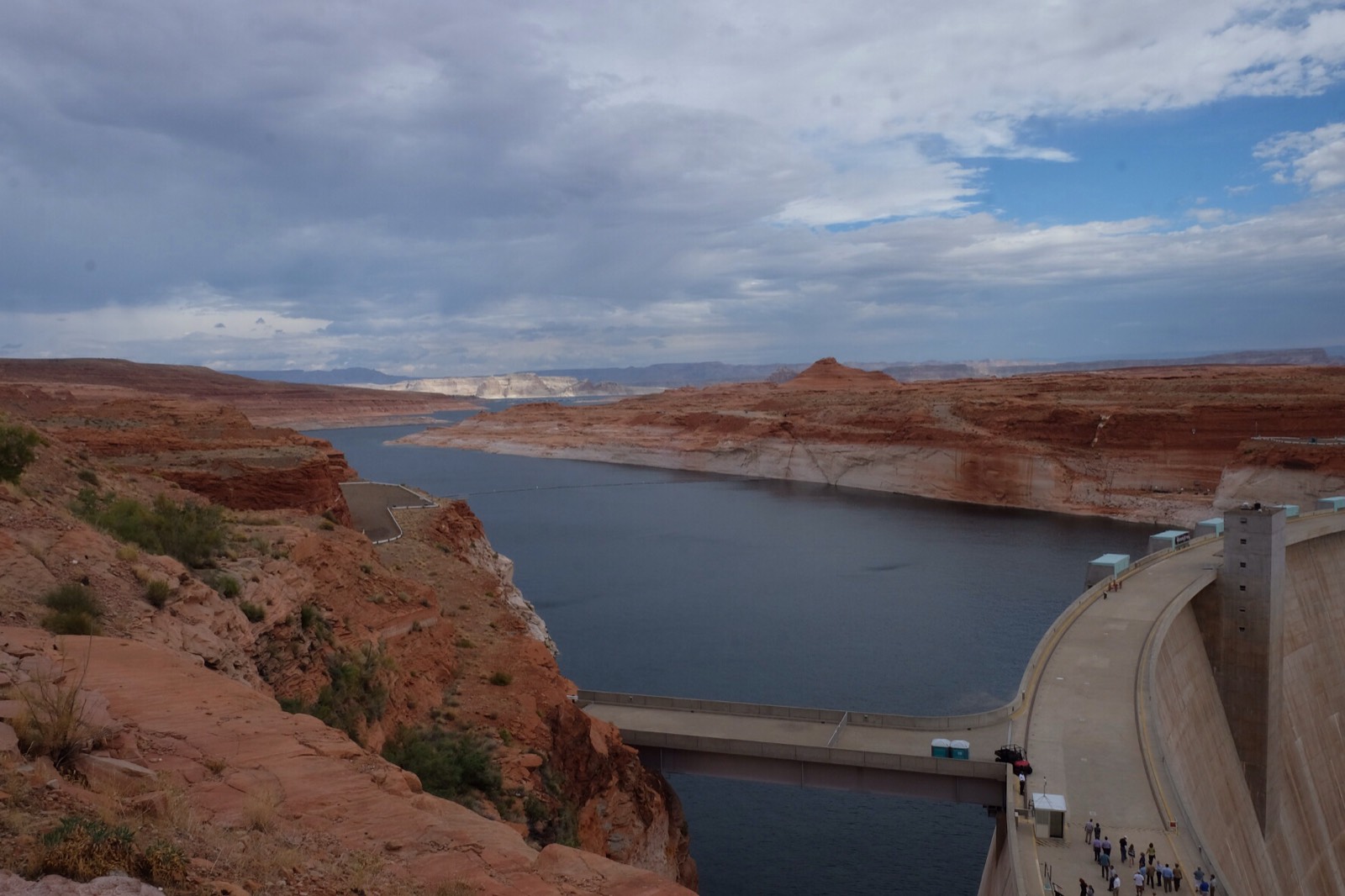
Hero photo: Lake Powell and Glen Canyon Dam by the U.S. Department of the Interior, licensed CC BY-SA 2.0, via Wikimedia Commons.