
“Dead pool” is the phrase that shows up in almost every alarming Lake Powell headline. It has a precise, physical meaning — a single elevation on Glen Canyon Dam where the reservoir stops working the way it’s supposed to. That number is 3,370 feet, and the gap between it and today’s surface is wider than most headlines suggest.
The short answer
Dead pool is elevation 3,370 feet. Below it, Lake Powell’s surface drops under the last set of outlets in Glen Canyon Dam, so water can no longer be released downstream by gravity. The reservoir would still hold roughly 2 million acre-feet, but that water would be trapped. A different, higher line matters first: at 3,490 feet, the dam’s hydropower turbines shut down. The callout above shows how many feet of cushion remain today.
The thresholds, from full to empty
Lake Powell’s decline runs through a ladder of engineered elevations, each one a point where the dam loses a function:
| Elevation | Name | What happens here |
|---|---|---|
| 3,700 ft | Full pool | Maximum storage, about 24.3 MAF; full release and power flexibility |
| 3,648 ft | Spillway floor | Below this, the flood spillways can’t be used |
| 3,490 ft | Minimum power pool | Penstocks lose submergence; the 8 turbines shut down, hydropower stops |
| ~3,394 ft | Outlet-works floor | The lowest level Reclamation considers safe for sustained releases |
| 3,370 ft | Dead pool | Outlet intakes exposed; no gravity release possible |
| 3,132 ft | Riverbed | The original Colorado River channel at the dam |
The two lines that dominate the news are minimum power pool and dead pool. Everything below covers what each one really means.
What “dead pool” actually means
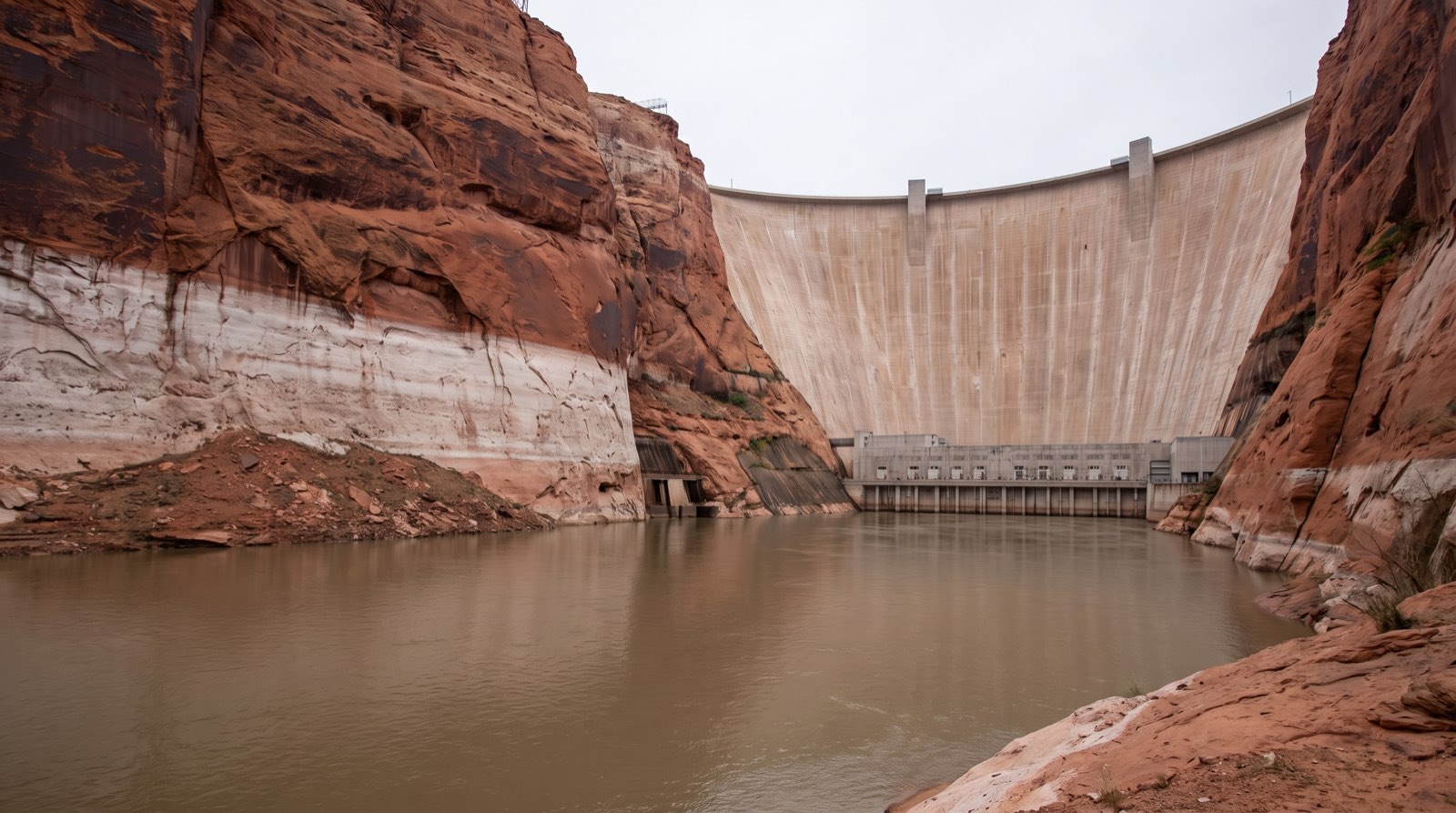
Dead pool is not an empty lake. It’s the elevation where the water surface falls below the river outlet works — the lowest pipes through Glen Canyon Dam — so nothing can be released through the structure by gravity. The U.S. Geological Survey’s 2018 elevation-capacity survey puts the dead storage benchmark at 3,372.91 feet on the NAVD 88 vertical datum; the Bureau of Reclamation commonly cites 3,370 feet, the invert of the outlet intakes. The two figures are close, measured against slightly different references.
At that point the reservoir would still hold on the order of 2 million acre-feet of water. But it would be stranded behind the dam, disconnected from the river below, rising and falling only with inflow, evaporation, and seepage. For the live distance between today’s level and this line, the dead pool tracker does the arithmetic against the current USBR reading.
One wrinkle worth knowing: the lake actually holds a little less than the original design figures suggest. The USGS survey found Powell has lost roughly 1.8 million acre-feet of capacity to sediment since 1963, so the storage curve keeps shifting as the delta fills in.
Dead pool vs. minimum power pool
These two get conflated constantly, and the difference is the whole story of how Glen Canyon Dam fails in stages.
Minimum power pool is 3,490 feet. Above it, water passes through pressurized penstocks to eight turbines that generate power. As the lake drops toward this line, those intakes lose the depth of water above them that keeps flow smooth. Too little submergence and the penstocks start pulling air, which risks cavitation damage, so Reclamation shuts the units down. Glen Canyon’s plant carries about 1,320 megawatts of capacity and supplies carbon-free power to roughly 5 million customers across seven Western states, so this is a serious line on its own, and it comes about 120 feet before dead pool.
Dead pool is 3,370 feet. Between the two, the dam can still move water, but only through the lower river outlet works, with no power generation at all. Below 3,370 feet, even those outlets are above the waterline. That 120-foot band is the reservoir’s margin between “expensive and constrained” and “physically cannot deliver.”
What would happen if Lake Powell hit dead pool
Two things break, in order.
First, hydropower is already gone by the time the lake nears dead pool, having stopped 120 feet higher. Utilities across the Upper Basin would be buying replacement power on the open market, and the revenue that funds dam operations and environmental programs at Glen Canyon would dry up with it.
Second, and bigger: controlled deliveries to the Grand Canyon and on to Lake Mead would stop. About 40 million people across seven states and Mexico depend on the Colorado River, and Glen Canyon Dam is the throttle for the Upper Basin’s share of that delivery. The river outlet works that would carry every release below minimum power pool weren’t built for the job long-term. They’re four bypass pipes with a combined capacity near 15,000 cubic feet per second, and Reclamation only considers them safe for sustained use down to about 3,394 feet. Public-radio reporting from KUNC has documented cavitation damage to these outlets at low levels, and engineers have described the system as “antique plumbing” that erodes under prolonged high-velocity flow. Running the whole river through them for months or years is a risk managers work hard to never take.
When could Lake Powell reach dead pool?
Honestly, not soon — and not in the forecast that Reclamation treats as most likely. This is the part the scariest headlines skip.
Reclamation manages to the minimum power pool line, not dead pool. Its projections, updated monthly in the 24-Month Study, show the lake approaching 3,490 feet under dry scenarios in late 2026 or 2027. Dead pool at 3,370 feet shows up only in the extreme, low-probability tail of those model runs, not the central case. The water year 2026 unregulated inflow was projected at about 3.27 million acre-feet, roughly a third of the long-term average. That chronically low inflow is why Lake Powell is so low in the first place, and it’s why the low-level scenarios are getting real attention this year.
So when you see “Lake Powell could hit dead pool by [date],” read it as an extreme scenario pulled from an ensemble, not a prediction. The honest framing is the one Reclamation uses: the near-term risk is losing hydropower, and dead pool is the worst-case line beyond that. For where levels are actually projected to head, the forecast page and Will Lake Powell fill back up? both lay out the ranges.
How managers are trying to prevent it
Reclamation has tools, and it’s using them. Under the Drought Response Operations Agreement, it’s releasing between 660,000 and 1 million acre-feet from Flaming Gorge Reservoir upstream to prop Powell up through April 2027. It can also cut releases from Powell down to Lake Mead below the normal benchmark to hold elevation, which trades Powell’s cushion against Mead’s.
There’s a live debate running alongside the engineering. Groups like the Glen Canyon Institute argue for a “Fill Mead First” strategy that would deliberately consolidate the system’s water in Lake Mead rather than split it between two half-empty reservoirs. Reclamation isn’t operating that way today, but the fact that draining Powell is even on the table tells you how far the conversation has moved. The live side-by-side is on Lake Powell vs. Lake Mead.
Has it ever come close?
Not to dead pool. The 2023 low of 3,519.92 feet (April 13, 2023) sat about 150 feet above dead pool, but only around 30 feet above minimum power pool. That spring was the first real scare, and a huge 2023 snowpack pulled the lake back before the turbines were threatened.
On August 15, 2026 the lake fell below the 2023 mark and reset the modern record; see how low is Lake Powell for how today’s level stacks up against it. Every winter since has moved levels up or down with the snow; the water level chart holds the full 365-day record, and the callout at the top of this page shows where things stand right now.
Sources
- U.S. Bureau of Reclamation — Glen Canyon Dam / Lake Powell operations (thresholds, releases, water year 2026 inflow projection)
- U.S. Geological Survey — Elevation-Area-Capacity Relationships of Lake Powell in 2018, SIR 2022-5017 (dead storage benchmark, sediment loss)
- U.S. Bureau of Reclamation — Colorado River Basin (system storage, dependent population)
- U.S. Bureau of Reclamation — Flaming Gorge / drought response operations (upstream releases to Lake Powell)
- KUNC — “A plumbing issue at this Lake Powell dam could cause big trouble for Western water” (river outlet works, cavitation)
- Water Education Colorado — Glen Canyon Dam hydropower and the megadrought (per-unit output at low levels)