
“Lake Powell is drying up” is one of the most common things said about the reservoir, and one of the most misunderstood. The lake really is shrinking, and fast. But the version in the scariest headlines, a reservoir about to vanish into bare rock, isn’t what the data shows.
The short answer
Lake Powell is shrinking, and in 2026 it fell to its lowest summer level in recorded history. But it will not literally dry up. Even at dead pool, elevation 3,370 feet, the reservoir would still hold millions of acre-feet, and a strong snow year can still add dozens of feet. What’s genuinely at risk is the lake’s usable storage, its hydropower, and its ability to send water downstream.
What people mean by “drying up”
Three very different ideas get folded into that one phrase. Keeping them separate is the whole point:
- Shrinking — losing surface elevation and storage. This is real and ongoing. The lake is far below where it was in 1999.
- Losing function — dropping below minimum power pool (3,490 feet), where hydropower stops, or dead pool (3,370 feet), where releases through the dam stop. These are the thresholds that actually keep water managers up at night.
- Vanishing — becoming a dry, empty canyon. This one isn’t supported by the hydrology, and it’s the version headlines lean on hardest.
The first is happening now. The second is the looming risk. The third is not on the table.
How far it has fallen
Lake Powell reached full pool, 3,700 feet, in June 1980 and peaked at 3,708.34 feet in July 1983. Then came the 21st-century drought. The reservoir fell to 3,519.92 feet on April 13, 2023 — about 180 feet below full pool, and only around 30 feet above the level where Glen Canyon Dam would have stopped generating power. On August 15, 2026 it dropped below that mark, resetting the modern record low.
2026 pushed the water back toward that territory. After a winter that produced roughly a third of the basin’s average inflow, and one of the lowest spring runoffs on record, news outlets reported that Lake Powell hit its lowest summer level in recorded history. The water level chart holds the full 365-day trajectory, and the callout above shows exactly where the lake sits today against full pool and dead pool.
Can Lake Powell actually dry up completely?
No, and this is the part the doom framing gets wrong. Lake Powell is a deep reservoir in a narrow canyon. Even if it fell all the way to dead pool at 3,370 feet, it would still hold millions of acre-feet of water. The U.S. Bureau of Reclamation defines that elevation as the bottom of the dam’s river outlet works: below it, water can’t be released through Glen Canyon Dam, but it doesn’t stop existing. It sits in the canyon.
Inflow keeps arriving, too. The Colorado and San Juan rivers still feed the reservoir every spring, even in dry years. A shrinking Lake Powell loses the storage and the head that make it useful. It doesn’t turn into an empty desert.
You may have seen the headline that “Lake Powell could dry up in as little as six years.” There’s no formal study behind that number. It’s a paraphrase of Reclamation’s warnings that the lake could approach critical low elevations within a few years, a concern about the dam’s function rather than the basin going dry.
What “drying up” actually threatens
The stakes are serious, just different from the headline. Two things break as the lake falls:
- Hydropower, at 3,490 feet. Below minimum power pool, Glen Canyon Dam’s turbines shut down. Reclamation’s projections have shown the lake could approach that line under dry scenarios as soon as late 2026.
- Downstream delivery, at 3,370 feet. At dead pool, water can no longer pass through the dam by gravity, so releases to the Grand Canyon and Lake Mead would stop. The full mechanics are in What is Lake Powell’s dead pool?
Neither of those is the reservoir disappearing. Both are why managers are releasing extra water from upstream reservoirs like Flaming Gorge to keep Powell’s elevation up.
What it looks like as the water drops
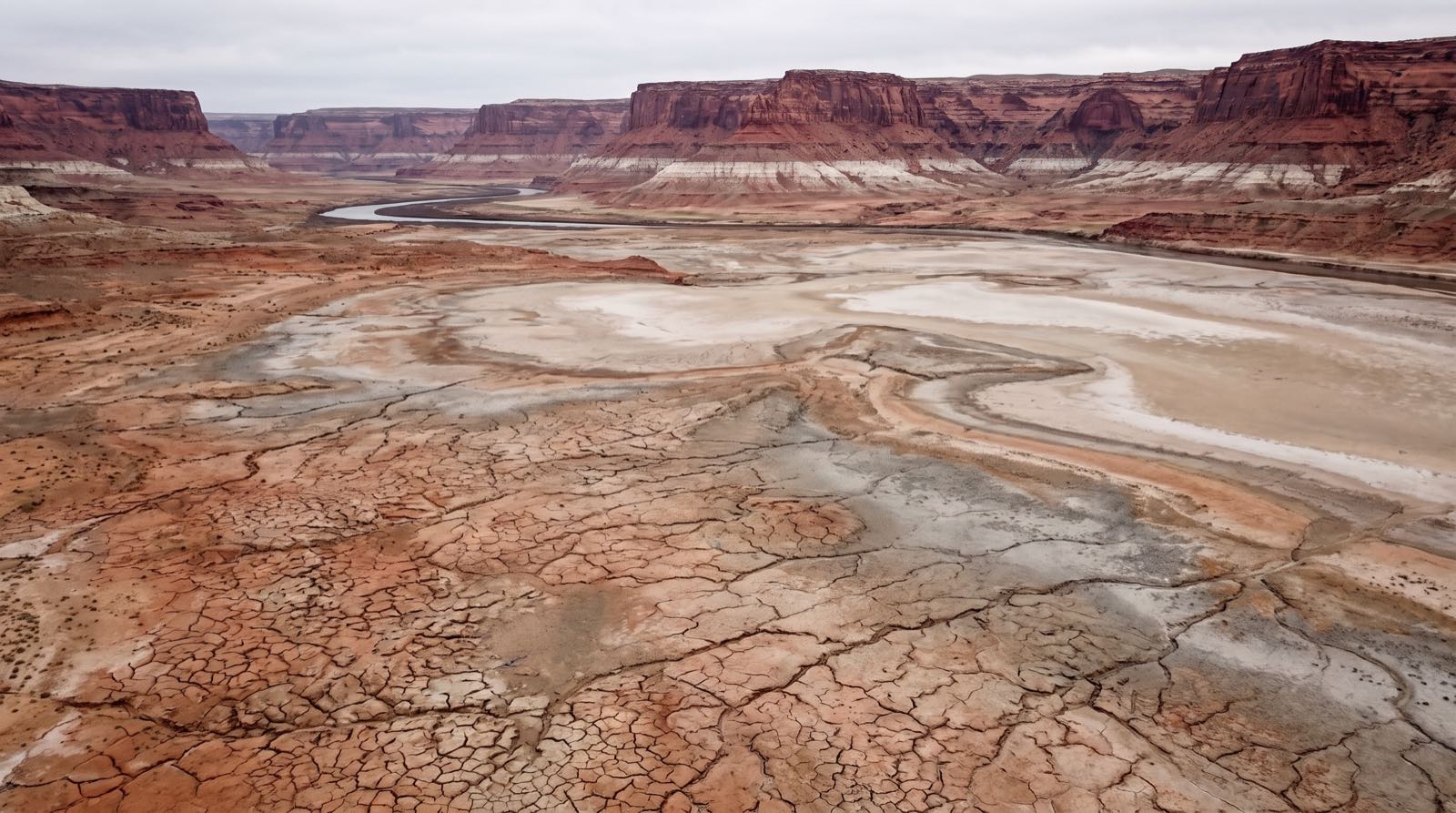
The shrinking is visible, and it cuts both ways. As the reservoir retreats, side canyons, arches, and stretches of Glen Canyon that were underwater for half a century are re-emerging, along with sediment flats and old river channels. Some river advocates see that exposure as a restoration opportunity rather than only a loss.
The changes carry downstream as well. Warmer water drawn from a lower reservoir and passed through the dam has helped invasive smallmouth bass establish below Glen Canyon, a documented threat to native fish in the Grand Canyon reach. A lower lake reshapes the ecosystem on both sides of the dam.
Could it recover?
Yes, at least partly. Lake Powell rises and falls on a seasonal schedule, and a single big winter can lift it substantially: the strong 2023 snowpack pulled the reservoir roughly 65 feet off its record low. What’s much less likely is a full recovery to 3,700 feet, because a hotter basin keeps taking flow off the top. The deeper backstory on the decline is in Why is Lake Powell so low?, and the odds of a rebound are covered in Will Lake Powell fill back up?. For where levels are projected to head next, see the forecast page.
Sources
- U.S. Bureau of Reclamation — Glen Canyon Dam / Lake Powell operations (elevation, storage, water year 2026 inflow)
- U.S. Bureau of Reclamation — Post-2026 Draft EIS (dead pool defined as the 3,370-foot outlet-works invert)
- The Colorado Sun — Lake Powell’s record-low spring runoff, May 2026
- U.S. Geological Survey — Elevation-Area-Capacity Relationships of Lake Powell, SIR 2022-5017 (storage at low elevations)
- Smallmouth bass and declining reservoir elevations, Canadian Journal of Fisheries and Aquatic Sciences (2025)
- National Park Service — Glen Canyon NRA, Changing Lake Levels