
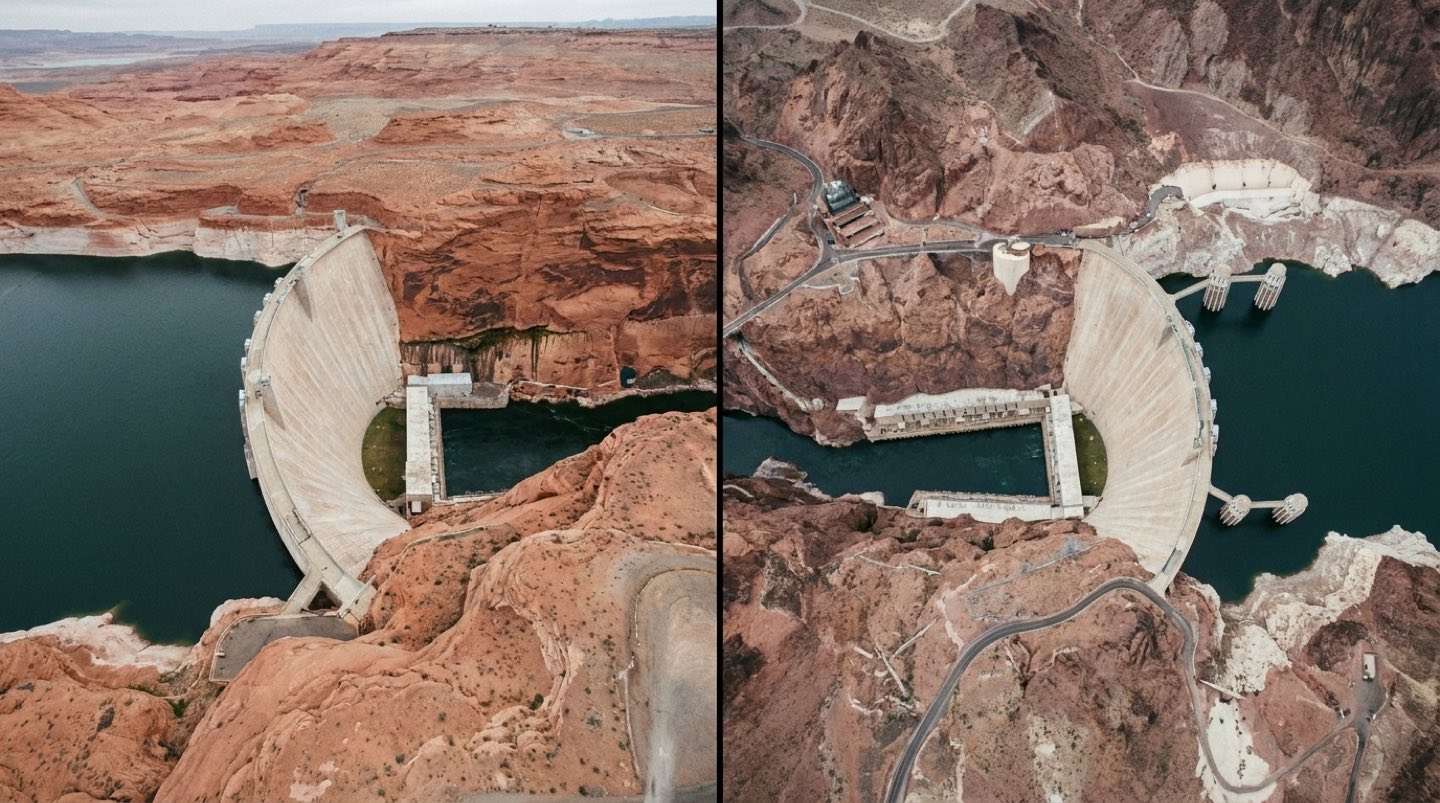
Hoover Dam and Glen Canyon Dam are the two structures that hold the modern Colorado River together. They look alike, they were built by the same agency, and people mix them up constantly. But they sit 300 river miles apart, do different jobs, and back up the two largest reservoirs in the country.
The short answer
Hoover Dam is the taller, older dam. It was dedicated in 1935 on the lower Colorado at the Arizona–Nevada border, stands 726 feet high, and holds back Lake Mead, the largest reservoir in the United States. Glen Canyon Dam is the younger, wider dam. It was completed in 1963 on the upper Colorado near Page, Arizona, stands 710 feet high with a longer crest, and holds back Lake Powell. Both are concrete arch-gravity dams run by the U.S. Bureau of Reclamation, and they are operated as a linked pair.
Glen Canyon Dam vs. Hoover Dam at a glance
Here are the fixed engineering numbers, side by side. For how full each reservoir is today, see the live Lake Powell vs. Lake Mead comparison, since those figures change daily.
| Glen Canyon Dam | Hoover Dam | |
|---|---|---|
| Reservoir | Lake Powell | Lake Mead |
| Completed | 1963 (last concrete; dedicated 1966) | 1935 (built 1931–1936) |
| Location | Upper Colorado, near Page, AZ | Lower Colorado, AZ–NV border |
| Structural height | 710 ft | 726 ft |
| Crest length | 1,560 ft | 1,244 ft |
| Dam type | Concrete arch-gravity | Concrete arch-gravity |
| Power capacity | 1,320 MW | 2,080 MW |
| Reservoir capacity | ~24.3 MAF | ~26 MAF |
| Basin role | Upper Basin storage | Lower Basin delivery + flood control |
Which dam is bigger?
Neither wins outright, which is why the question comes up so often. Hoover is the taller of the two: 726 feet from bedrock to crest, against Glen Canyon’s 710 feet, per the Bureau of Reclamation. Reclamation calls Glen Canyon the second-highest concrete-arch dam in the country, second only to Hoover.
Flip the measurement, though, and Glen Canyon leads. Its crest runs 1,560 feet across the canyon, more than 300 feet longer than Hoover’s 1,244-foot crest. The reservoirs are a near tie: Lake Mead edges out Lake Powell at full pool, roughly 26 million acre-feet to 24.3, making Mead the largest reservoir in the United States by capacity and Powell the second-largest. Powell wins on shoreline, wrapping about 1,960 miles of canyon against Mead’s 750.
Which dam makes more power?
Hoover has the bigger power plant, but Glen Canyon does more with less. Hoover’s plant carries a nameplate capacity near 2,080 megawatts, well above Glen Canyon’s 1,320 megawatts (Reclamation). Yet Glen Canyon typically generates more electricity over a full year, about 5 billion kilowatt-hours to Hoover’s roughly 4 billion. That gap comes down to how each plant is run, not the size of its turbines.
Glen Canyon’s power plant is the workhorse of the Colorado River Storage Project, and the Western Area Power Administration markets its output to utilities across seven Western states. That hydropower is one reason the lake’s level matters so much: below 3,490 feet, minimum power pool, the turbines can no longer run. At today’s elevation the water level chart tracks exactly how much cushion is left.
How the two dams work together
Powell and Mead are two buckets on the same tap, and Glen Canyon Dam controls the upper one. Snowmelt from the Rockies fills Lake Powell first. Water released through Glen Canyon Dam then travels about 300 miles down the Colorado, through the Grand Canyon, and into Lake Mead behind Hoover Dam, which supplies Las Vegas, Arizona, California, and Mexico.
Because of that plumbing, federal operators balance storage between the two reservoirs on a schedule. When Reclamation holds water back in Powell to protect hydropower or to slow its decline, less arrives in Mead. The two lakes tend to rise and fall together, though a dry year or a coordinated release can pull them apart. Watching Powell is still one of the earliest reads on where the whole system is heading. The full picture lives on the Lake Powell vs. Lake Mead page.
Why does the river need both dams?
Because they were built to solve different problems, a generation apart. Hoover came out of the Boulder Canyon Project Act of 1928, meant to tame the lower river’s floods, store water for California and Arizona, and generate power for a booming Southwest. It was the tallest dam in the world when it went up.
Glen Canyon came out of the Colorado River Storage Project Act of 1956, built to give the Upper Basin states a “savings account.” Lake Powell banks water in wet years so the Upper Basin can still meet its delivery obligations to the Lower Basin in dry ones. That role is exactly why the reservoir has fallen so far during the current drought, the subject of why Lake Powell is so low.
Will Glen Canyon Dam be removed?
No removal is planned, though the idea has real advocates. The Glen Canyon Institute has long pushed “Fill Mead First,” which would drain Lake Powell and consolidate the system’s water in Lake Mead rather than splitting it between two half-empty reservoirs. Supporters argue it would cut evaporation and seepage losses; Reclamation and the Upper Basin states have not adopted it, and the dam’s hydropower and Upper Basin storage role keep it central to operations.
The more immediate question is not the dam but the water behind it. If Lake Powell keeps dropping toward dead pool, Glen Canyon Dam’s ability to release water and make power is what’s at stake, not the concrete itself.
Sources
- U.S. Bureau of Reclamation — Hoover Dam FAQs: dam dimensions and construction (726 ft height, 1,244 ft crest, construction dates)
- U.S. Bureau of Reclamation — Hoover Dam FAQs: power plant (~2,080 MW capacity, ~4 billion kWh/yr)
- U.S. Bureau of Reclamation — Glen Canyon Dam / Colorado River Storage Project (710 ft height, second-highest concrete-arch dam, 1,320 MW, ~5 billion kWh/yr)
- U.S. Bureau of Reclamation — Colorado River Storage Project Act overview (1956 authorization, Upper Basin “savings account” role)
- U.S. Bureau of Reclamation — Hoover Dam / Boulder Canyon Project (1928 authorization, Lower Basin flood control and delivery)
- U.S. Geological Survey — reservoir storage-capacity survey, SIR 2022-5017 (Lake Mead and Lake Powell capacities and ranking)