
Utah stores most of its water behind dams, and one of those dams holds more than all the others put together. Ranked by how much water each can hold, the state’s reservoir list drops off a cliff after the first entry.
The short answer
Lake Powell is Utah’s largest reservoir, with a total capacity of 25.16 million acre-feet — roughly three times the combined capacity of the next nine on this list. Flaming Gorge Reservoir is second at 3,788,799 acre-feet, and Bear Lake third on the strength of 1.4 million acre-feet of regulated storage.
The ranking uses storage capacity in acre-feet, the volume of water each reservoir can hold and release. For the two natural lakes that appear here, Bear Lake and Utah Lake, only the dam-regulated portion counts, which is why they sit lower than their raw lake volumes would suggest. Utah’s top three are also all shared: Powell with Arizona, Flaming Gorge with Wyoming, Bear Lake with Idaho.
Utah’s 10 largest reservoirs
| # | Reservoir | Dam / river | Capacity (acre-feet) | Surface area (acres) |
|---|---|---|---|---|
| 1 | Lake Powell | Glen Canyon Dam, Colorado | 25,160,000 | 159,200 |
| 2 | Flaming Gorge Reservoir | Flaming Gorge Dam, Green | 3,788,799 | 42,020 |
| 3 | Bear Lake | outlet works, Bear River | 1,400,000 regulated | ~71,000 |
| 4 | Strawberry Reservoir | Soldier Creek Dam, Strawberry | 1,106,500 | 17,160 |
| 5 | Utah Lake | Jordan River control works | 870,000 | ~95,000 |
| 6 | Jordanelle Reservoir | Jordanelle Dam, Provo | 363,000 | 3,024 |
| 7 | Willard Bay | Arthur V. Watkins Dam, off-stream | 215,120 | ~10,000 |
| 8 | Sevier Bridge (Yuba) | Sevier Bridge Dam, Sevier | 205,160 | 9,677 |
| 9 | Starvation Reservoir | Starvation Dam, Strawberry | 167,310 | 3,310 |
| 10 | Deer Creek Reservoir | Deer Creek Dam, Provo | 152,570 | 2,965 |
1. Lake Powell — 25.16 million acre-feet
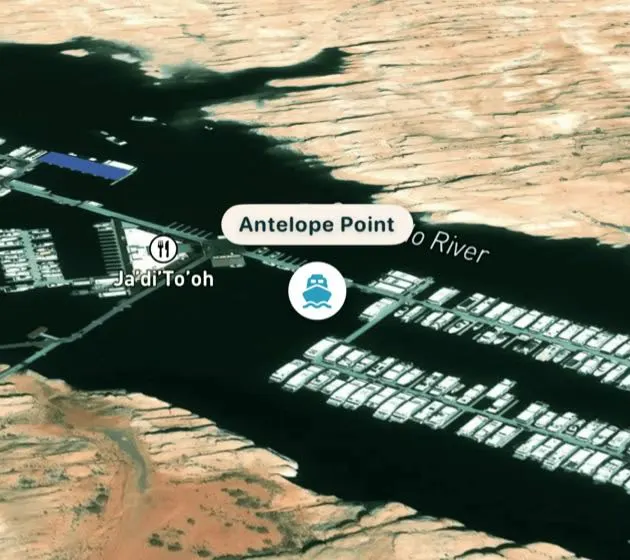
Glen Canyon Dam sits in Arizona, but most of the reservoir behind it lies in Utah, flooding nearly 200 miles of canyon upstream toward Hite. A 2017–2018 topobathymetric survey by the USGS and the Bureau of Reclamation put total storage at 25,160,000 acre-feet across 159,200 acres at full pool — down 1,833,000 acre-feet, or 6.79%, from the 1963 figure as sediment filled the bottom of the canyon.
That single reservoir is the reason Utah’s water picture cannot be read from the state’s own reservoir numbers. Powell is a Colorado River Storage Project unit operated for the whole Upper Basin, not a Utah municipal supply, and its level answers to snowpack across Colorado, Wyoming, and Utah alike. Today’s reading is in the callout above and on the live tracker; the past year sits on the water level chart.
2. Flaming Gorge Reservoir — 3,788,799 acre-feet
The Green River backs up 91 miles behind Flaming Gorge Dam, crossing from Utah into Wyoming along the way. Reclamation gives the reservoir a full capacity of 3,788,799 acre-feet at elevation 6,040 feet, with 3,749,000 acre-feet of that active, a surface area of 42,020 acres, and 375 miles of shoreline (USBR).
Flaming Gorge is the other Utah reservoir that answers to the Colorado River system rather than to Utah alone. Reclamation has repeatedly drawn it down to prop up Lake Powell — a set of releases that makes it the closest thing Powell has to a reserve tank. It is also the largest reservoir in Wyoming, which is why it turns up on two states’ lists at once.
3. Bear Lake — 1.4 million acre-feet of regulated storage
Bear Lake is a natural lake straddling the Utah–Idaho line, and its turquoise color comes from suspended carbonates rather than anything an engineer built. Pumps and outlet works added in the early twentieth century turned its upper layer into working irrigation storage. Utah’s Division of Water Rights describes the operator’s rights and facilities as sufficient to “regulate (and use as a reservoir) the top 1.4 million acre-feet of Bear Lake’s 6.5 million acre-feet of storage volume” (Bear River Compact findings).
So Bear Lake holds more water than any Utah reservoir except Powell, and stores less of it than Strawberry does in practice. Utah State Parks puts the lake at 112 square miles, about 71,000 acres, with a full elevation of 5,923.65 feet (Utah State Parks).
4. Strawberry Reservoir — 1,106,500 acre-feet
Strawberry is the largest reservoir lying entirely inside Utah. The original 1913 dam was superseded by Soldier Creek Dam, whose 1972 enlargement brought capacity to 1,106,500 acre-feet (Department of the Interior) and roughly doubled the water surface to about 17,160 acres (USBR).
The reservoir anchors the Strawberry Aqueduct and Collection System, which gathers ten streams tributary to the Strawberry and Duchesne rivers and moves about 101,900 acre-feet a year west across the Wasatch. Water that would have run to the Colorado River instead ends up in Utah County taps.
5. Utah Lake — 870,000 acre-feet
Utah Lake is natural, shallow, and enormous in area: roughly 95,000 acres with an average depth around nine feet. Control works at its Jordan River outlet make it a storage facility as well. At the compromise elevation of 4,489.045 feet, the Utah Division of Water Rights puts total volume at 870,000 acre-feet, of which 710,000 acre-feet is active storage (Utah Lake Interim Water Distribution Plan).
Depth is what keeps it off the top of the list. Spread that volume over 95,000 acres and the lake is thinner than a two-story building is tall, which also makes it a heavy evaporator relative to what it stores.
6. Jordanelle Reservoir — 363,000 acre-feet
Jordanelle Dam closed on the Provo River above Heber in 1993, the last major piece of the Central Utah Project’s municipal and industrial system. Interior gives the reservoir a total capacity of 363,000 acre-feet across about 3,024 surface acres at full pool (DOI); Reclamation’s project listing cites 320,300 acre-feet, the figure at the top of active storage.
Both numbers are correct for what they describe, and the 42,700 acre-foot gap between them is a good illustration of why published reservoir rankings disagree so often.
7. Willard Bay — 215,120 acre-feet
Willard Bay is the odd one on this list: an off-stream reservoir walled off from the Great Salt Lake by the Arthur V. Watkins Dam, filled by canal from the lower Weber and Ogden rivers rather than by a river running into it. Reclamation’s project description gives the enclosed reservoir a 215,120 acre-foot capacity (Weber Basin Project) over roughly 10,000 acres, and that is the figure used in the ranking above.
A 2015–2016 crest raise lifted total storage to roughly 250,000 acre-feet (USBR). Either number puts Willard Bay seventh, so the rank does not turn on which one a list picks — but the 35,000 acre-foot spread between them is a fair sample of how much these published figures move.
8. Sevier Bridge (Yuba) Reservoir — 205,160 acre-feet
The largest reservoir on the Sevier River, and the largest on this list not operated by a federal or state agency — Consolidated Sevier Bridge Reservoir Company has run it since 1914. Utah’s dam-safety record lists 205,160 acre-feet of storage at spillway crest over 9,677 acres, and 363,000 acre-feet at dam crest (Utah Division of Water Rights). The conservation figure is the one that belongs in a capacity ranking; the dam-crest number counts flood surcharge the reservoir never holds in normal operation.
9. Starvation Reservoir — 167,310 acre-feet
Starvation sits on the Strawberry River just west of Duchesne and works as the receiving end of the Central Utah Project’s exchange: water diverted out of the Uinta Basin at Strawberry is repaid here. Interior gives it a storage capacity of 167,310 acre-feet (DOI), with a water surface of 3,310 acres and 32 miles of shoreline in the Corps of Engineers’ water control manual.
10. Deer Creek Reservoir — 152,570 acre-feet
Deer Creek closed the Provo River canyon in 1941 and remains the workhorse of Wasatch Front municipal supply. Reclamation gives it a 152,570 acre-foot capacity, of which 110,000 acre-feet is assigned to flood control (Provo River Project); Utah State Parks puts maximum surface area at 2,965 acres (Deer Creek State Park).
That flood-control assignment matters for anyone comparing reservoirs by size. Two-thirds of Deer Creek’s nominal capacity exists to absorb a runoff peak, not to hold water through a dry August.
Just outside the top 10
The next tier drops under 120,000 acre-feet, and it is where most of Utah’s familiar recreation reservoirs sit. All figures below come from Reclamation’s Weber Basin Project description except Echo and Scofield.
| Reservoir | Capacity (acre-feet) | Surface area (acres) |
|---|---|---|
| Pineview Reservoir | 110,150 | — |
| Echo Reservoir | 73,940 | 1,455 |
| Scofield Reservoir | 73,600 | 2,815 |
| Rockport Lake (Wanship Dam) | 62,100 | 1,080 |
| East Canyon Reservoir | 51,200 | 684 |
| Lost Creek Reservoir | 22,510 | 365 |
Echo’s figures come from Reclamation’s dam safety environmental assessment and Scofield’s from the Utah Division of Wildlife Resources’ fisheries management plan.
Utah’s biggest lakes are not its biggest reservoirs
Two water bodies beat everything on the ranking for sheer surface and appear on no reservoir list. The Great Salt Lake is a terminal saline lake with no outlet and no storage function — nothing is released from it, so it holds no capacity in the water-management sense. Fish Lake, high in the Fishlake National Forest, is the state’s largest natural freshwater mountain lake and is trivially small by volume next to any reservoir here.
Bear Lake and Utah Lake sit in between, which is why they are ranked on their regulated storage rather than their full volume. Counting Bear Lake’s entire 6.5 million acre-feet would put it second in Utah and rewrite the list — and would also describe water nobody can deliver to a canal.
Why published rankings of Utah reservoirs disagree
Three definitional traps account for most of the contradictions between lists.
- Capacity or surface area. These rank differently. Utah Lake covers about 95,000 acres and stores 870,000 acre-feet; Jordanelle covers 3,024 acres and stores 363,000. By area Utah Lake is 31 times larger; by volume, only about 2.4 times.
- Which capacity. Gross or dam-crest capacity includes flood surcharge that is never held. Conservation or active capacity counts water actually available. Sevier Bridge is listed at 363,000 acre-feet at dam crest and 205,160 at spillway crest, a difference big enough to move it several places.
- Natural lakes counted as reservoirs. A list that includes Bear Lake’s total volume, or the Great Salt Lake at all, is measuring something other than storage.
Then there is the survey-vintage problem that hits Lake Powell hardest. Sediment has cut its capacity by 6.79% since 1963, so any ranking still citing 27 million acre-feet is describing a reservoir that no longer exists.
How full are they right now?
Capacity is what these reservoirs can hold. Storage is what they actually hold, and in mid-2026 the two numbers were far apart across the state.
The Utah Division of Water Resources tracks conditions at 47 reservoirs chosen for data availability and consistency, and rolls them into one statewide figure. It put statewide reservoir storage at 64% of capacity on July 2, 2026, about 11 percentage points below normal for early July and 15 points below the same week in 2025, after what the state described as the warmest winter and lowest snowpack on record (Utah DWR). Flaming Gorge sat at 75% of live capacity in early July (Reclamation).
Lake Powell is a separate story, and the state reports it separately for good reason: it is a system reservoir an order of magnitude larger than anything else in Utah, and it has been running near the bottom of its modern range. Its current elevation and percent full are in the callout at the top of this page, updated daily from Reclamation’s gauge. How close the drawdown is to the operational floor is tracked on the dead pool page, and the seasonal outlook sits on the forecast page.
For the national picture, Lake Powell ranks second among the largest man-made lakes in the U.S. behind Lake Mead, and the two are compared head-to-head on Lake Powell vs. Lake Mead. Where Powell’s water comes from in the first place is covered in where Lake Powell gets its water.
Sources
- U.S. Geological Survey — Elevation–Area–Capacity Relationships of Lake Powell, SIR 2022-5017 (25.16 MAF capacity, 159,200-acre surface, sediment loss since 1963)
- U.S. Bureau of Reclamation — Flaming Gorge Dam (3,788,799 AF capacity, 42,020 acres, 375 miles of shoreline)
- Utah Division of Water Rights — Bear River Compact findings (top 1.4 MAF of Bear Lake’s 6.5 MAF regulated as reservoir storage) and Utah Lake Interim Water Distribution Plan (870,000 AF total, 710,000 AF active at compromise elevation)
- U.S. Department of the Interior, Central Utah Project — Strawberry Aqueduct and Collection System, Municipal and Industrial System, Starvation Collection System
- U.S. Bureau of Reclamation — Weber Basin Project and Provo River Project (capacities and surface areas for Willard Bay, Pineview, Rockport, East Canyon, Lost Creek, Deer Creek)
- Utah Division of Water Rights — Sevier Bridge Dam safety record (205,160 AF at spillway crest, 9,677 acres, 363,000 AF at dam crest)
- Utah Division of Water Resources — statewide water conditions update, July 2, 2026 (64% of capacity statewide)
- Utah State Parks — Bear Lake and Deer Creek State Park (surface areas and full-pool elevations)
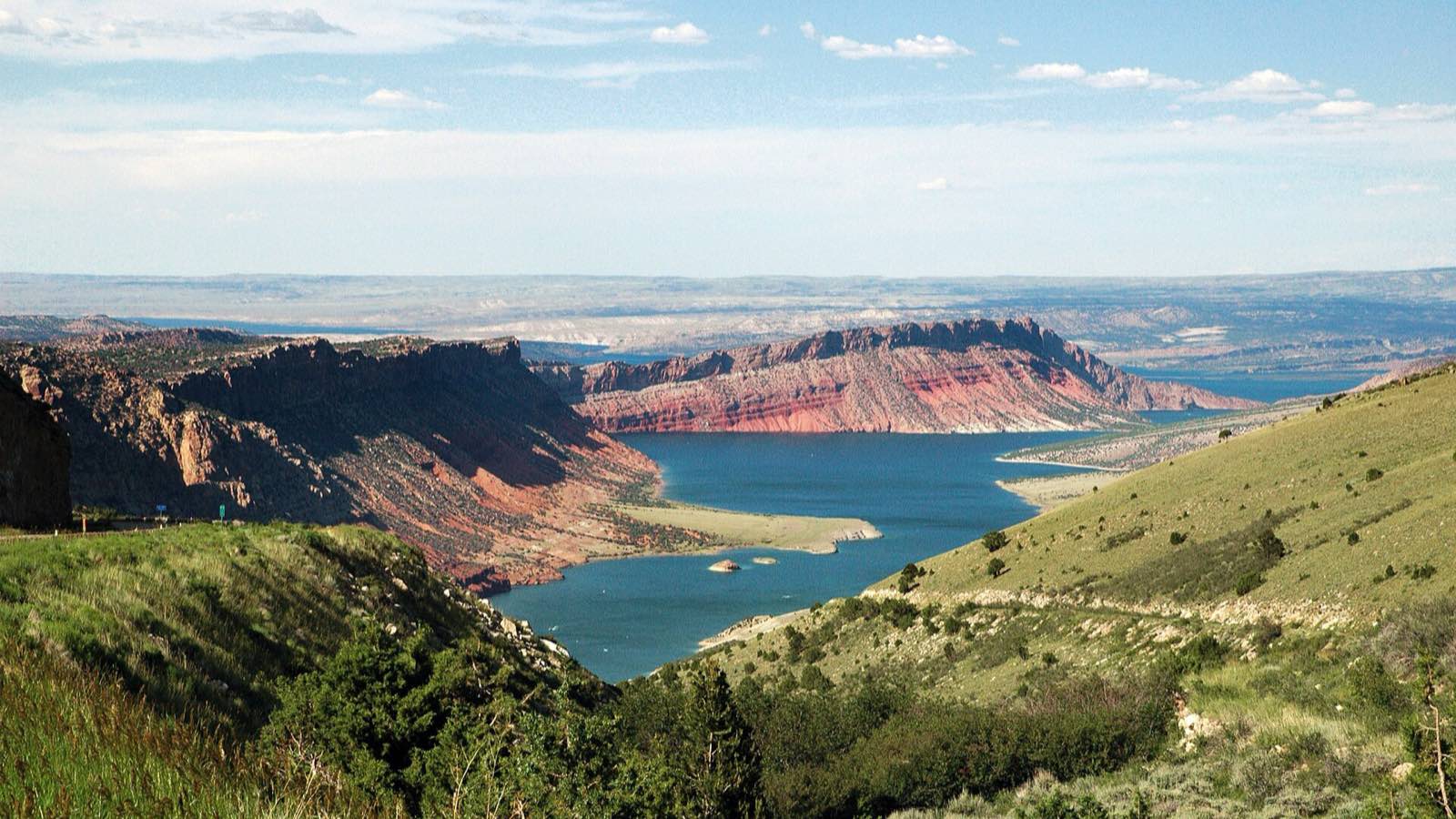
Hero image: Evening view of Flaming Gorge from Sheep Creek Overlook by DimiTalen — CC0, via Wikimedia Commons (cropped).